Peking Duck (hung-oven)
Follows the hung-oven standard as written; a home-oven version comes with the kitchen rewrites (phase 2)
Inflated, scalded, glazed with 13% maltose and dried 8–12 h, then hung over a fruitwood fire at 200–220 °C for 60–70 min until jujube red; carved and served with pancakes
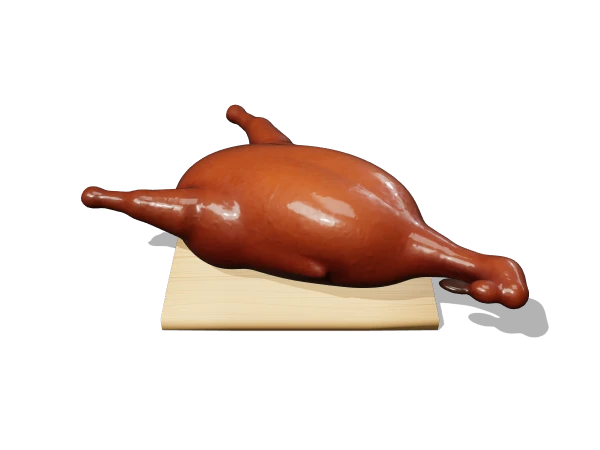
Preparing 3DThe ingredients and steps are below if you want to start there
Drag to rotate · Click a label for the amountDrag sideways to turn · tap a label for the amountTap a dot for the amount · drag sideways to turn
About this source
- Issued by the Beijing Cuisine Association; proposed and drafted by its Master Chefs Committee
- In force since 1 Feb 2019. The full text is a free PDF linked from the association’s release notice of 29 Dec 2018 (printed “internal material, free exchange”); China’s group-standards platform lists it as not for sale. Ingredients, amounts, equipment, temperatures and times all follow it
Not in the source — added by us (4)
- Times the standard gives are followed: scald under 10 s, dry 8–12 h, roast 60–70 min. Times marked as estimates are ours: the standard gives none for choosing, inflating, hooking, glazing, preheating, plugging, carving or plating
- Maltose water: the standard gives 50 g maltose and a 13% solution; the water (about 335 ml) is our estimate, assuming all 50 g goes in and the percentage is by weight
- Onion shreds are taken as Welsh onion (the standard just says onion); the duck is entered as 2750 g, the middle of 2.5–3 kg, and the cavity water as 90 ml, the middle of 80–100 ml
- The standard says nothing about how many slices or how to eat it; the size and look of the 3D duck and the slice count are ours
Other references (3)
- Web recipe“Commentary on T/BJCA 001-2018 and T/BJCA 002-2018, the hung-oven and closed-oven roast duck standards” · Beijing Cuisine Association commentary · 2018-12Open the original · Beijing Cuisine Association; linked from the same release notice as the two standards · Only two points are used: §5.2 says duck blanks in Beijing now mostly arrive pre-processed from duck farms, so that processing is left out of the steps; §5.3 says carving and plating vary, so the standard doesn’t fix them
- Heritage listing“Roast duck techniques (Quanjude hung-oven roast duck)” · National intangible heritage Ⅷ-167 · 2008Open the original · Second national list of intangible cultural heritage (2008); safeguarding unit: China Quanjude (Group) Co., Ltd. · Background only: the listing says hung-oven duck is roasted over an open fruitwood fire, in four stages and 31 steps, but gives no recipe
- Association standardT/CCA 018—2020 “Peking duck blanks” · China Cuisine Association standard · 2020-12-07 · Issued by the China Cuisine Association · Cited by name for what a duck blank is; China’s group-standards platform marks its text “not public”, so nothing in the steps follows it
Ingredients
Numbers match the labels on the 3D model
2750 g- 01Duck skinSkin of one duckRoasts jujube red and crisp; the first slices come off it
- 02Fat under the skinA layer under the skinMostly renders away in the oven, leaving a thin layer
- 03Duck meatDressed duck, 2.5–3 kgThe standard calls for a Beijing force-fed duck
- 04Duck carcasscooking onlyWhat is left after carvingNot served; carcass soup is not part of this recipe
- 05Lotus-leaf pancakes20
- 06Welsh onion shreds100 gThe standard just says onion shreds; drawn as Welsh onion
- 07Cucumber batons150 g
- 08Sweet flour sauce120 g
- 09White sugar10 g
- 10Skin-on meat slicesBelow the breast, and the legsShaped like clove or apricot leaves; the slice count is illustrative
- 11Skin slicesSkin from the breastThe standard gives no slice count; the 3D is illustrative
- 12Maltose glazecooking only50 g maltose in water
- 13Boiling watercooking onlyFor scalding and the cavity
Cooking order
13 steps · about 9 h 52 min – 14 h 2 min total (some estimated)
● in the source our estimate
The “look for” cues follow the cited source but haven’t been checked line by line by a cook yet; those marked ○ are our own additions.
Pick a dressed Beijing duck of 2.5–3 kg: plump and fatty, skin unbroken and unbruised, creamy white, dry and free of feathers
Insert the air gun into the small cut at the throat (about 1 cm, made when removing the tongue) and pump air under the skin, smoothing out wrinkles, until the skin is evenly full
Look forThe skin puffs up evenly all over until it is fullsource
About a minute
Tip Cutting the side opening, gutting, propping and washing come next; that is blank processing, left out here (see the prep note)
Set the duck hook in the middle of the neck, 3 cm above the shoulders: straight, without tearing the neck skin or breaking the neck bone
Pour maltose water of 13% strength evenly over the scalded duck
Look forThe whole duck is coated, with no bare patchesour estimate
About a minute
Store the duck frozen at -18 °C. To roast, hang it in a drying room or cabinet for 8–12 hours at 15–23 °C and under 30% humidity, ducks not touching
Look forIntact; the breast is dry, not oily, faintly waxy yellow, with a clear net-like patternsource
TouchThe skin feels dry, not tackyour estimate
SmellNo off smellsource
8–12 hours at room temperature
Watch out Ducks that knock together crack and dent the skin
Burn fruitwood, jujube wood ideally (dense, long-burning, even heat); apricot, peach or pear wood will do. Heat the oven to 160–180 °C before the duck goes in
About 30 minutes
Wedge the plug into the vent so the juices stay in, then pour 80–100 ml of boiling water in through the cut under the ribs
At 200–220 °C, lift the duck in on the pole and hang it from the front or back beam; turn, rotate and flame it so it cooks evenly, usually 60–70 minutes
Look forEvenly jujube red all over, glossy with fatsource
LookThe skin is taut, with tiny bubbles of fat on itour estimate
SmellA rich roast-duck smellsource
Usually 60–70 minutes
If you see… (3 cases)
- Colouring unevenly; some patches still yellow: Turn and rotate the duck with the pole so the pale side faces the fire↻ keep going with this stepsource
- Evenly jujube red and glossy all over: Lift the duck out with the pole→ step 10source
- The skin is turning black or scorching in spots: Take it out right away→ step 10our estimate
Watch out Going in and coming out, don’t touch the fire guard, the wood or the oven mouth
When done, lift the duck out with the pole without touching the fire guard, the wood or the oven mouth
First slice off the breast skin, cut it into pieces and lay them on the plate skin side up
Look forYou can hear the skin crackle under the knifeour estimate
About 5 minutes
Carve the rest and the legs into skin-on slices shaped like clove or apricot leaves and lay them on the plate; plate the head, tail and tenderloin too
Tip The standard gives two other ways: willow-leaf strips, or all the skin first and then the meat, plated separately
Arrange neatly skin side up on a porcelain plate; serve with 20 pancakes, 10 g sugar, 120 g sweet flour sauce, onion and cucumber