Chaoshan Beef Hot Pot
Known as Chaoshan beef hot pot; written here after Chaozhou's local standard. Fresh yellow-cattle beef in ten cuts, from the snowflake-marbled neck to the sinewy hind shank, sliced 1–2.5 mm across the grain; each batch goes into boiling clear bone broth in a wire strainer, is lifted for about 2 seconds once the surface turns, then finished, 10–20 seconds by cut. Brisket fat and beef balls simmer a few minutes. Dipped in shacha, peanut and chili sauces
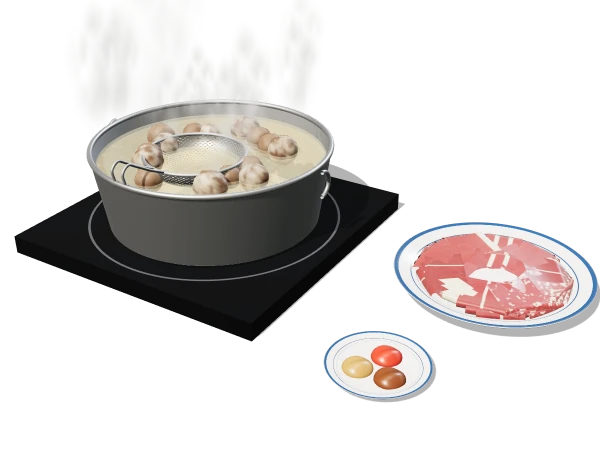
Preparing 3DThe ingredients and steps are below if you want to start there
Drag to rotate · Click a label for the amountDrag sideways to turn · tap a label for the amountTap a dot for the amount · drag sideways to turn
About this source
- Issued by the Chaozhou Administration for Market Regulation; drafted by the Chaozhou Cuisine Association, the Xiangqiao District market regulator, Hanshan Normal University and 22 others
- Recommended, in force since 20 Dec 2024 (filing no. 118613-2024); we read the full text in the local standards platform's online viewer. We follow it for the names of the ten fresh cuts and where they sit (table 2, figure A.19), the across-the-grain thickness (table 4), the amount and time per batch (table 5, times including the lift), broth by number of diners (table 3), the induction hob and double-hook strainer (4.2.1), the sauces (ch. 7), no plating (ch. 8) and eating within a minute (ch. 9). It calls the technique chao (焯); we keep the association standard's cuan (汆)
Not in the source — added by us (14)
- Sources changed: we read the full local standard DB4451/T 9—2024, made it the main source and follow it for cut names, thickness and times; the association standard T/CZSPTXH 148—2021 is background. Where they differ we follow the local one: thickness of jianzi and wuhuajian (2.0–2.5 mm vs 1.5–2.0 mm); batch size (75–100 g vs 100–125 g); xiongkoulao (2 min vs 3–5 min); the balls (5 min vs 3–5 min); broth (2.5–3.5 L vs by diners, 3.5–4.5 L for 2–4); the local standard's times include the lift
- Why ten cuts: table 1 of the local standard lists 11 fresh cuts; tongue and tripe are not drawn. Jianzi is sanhuazhi (the standard writes "jianzi (sanhuazhi)"), and diaolongban is the fatty part of diaolong ("diaolong (incl. diaolongban)", with its own photo A.9), shown as its own piece. So ten pieces on the animal; in the brief's eleven, sanhuazhi and jianzi were the same cut
- Diaolongban's time follows the "diaolong (incl. diaolongban)" row (10–12 s); table 4 gives no thickness for it, so we use diaolong's
- The ten are placed after figure A.19 and table 2 of the local standard. Two cells in the figure, the rear half of the back and of the belly, are unlabelled; we fold them into diaolong and feipian. Diaolongban is drawn as a fatty strip along diaolong's lower edge (Hunan Today: diaolong's two fat-edged sides). The figure also labels the upper foreleg "chibing 2%", which does not fit table 2 (chibing below the ribs); we follow table 2. These and all borders are our estimate
- Fat and grain follow table 2 and the photos in annex A: snowflake fat in xuehua, one sinew in chibing, yellow-white xiongkoulao, layered feipian, lean nenrou, sinewy wuhuajian. How much white and how many sinews are our estimate
- Slice thickness is the middle of table 4's range; length and width are not given and are estimated; the 3D shows 6 slices of each, for illustration
- The pot steps follow the order of table 5, one after another: xuehua, chiren, chibing, xiongkoulao, jianzi, diaolong, diaolongban, feipian, nenrou, wuhuajian, then the balls. The standard does not say which to eat first; Hunan Today (from Nanfang+) suggests fattiest to leanest. At the table the balls and xiongkoulao often simmer alongside the rest; here they go one after another
- A batch of 100–125 g is the standard's; one batch of each of the ten, about 1–1.25 kg in all, is our sum. Servings follow the broth in table 3 (2–4 people)
- The times for choosing the cuts, slicing, boiling the broth and the sauces are ours; poaching, xiongkoulao and the balls follow table 5 of the local standard
- The broth is taken as ready-made: the local standard (6.2.1) gives a method, beef bones simmered 3–4 hours and strained, which we put in the tip on the broth step rather than as a step. Galangal, cooked tendon and tripe, rice noodles, noodles, vegetables and the other condiments in the standard are not shown
- Safety: eating hot-pot meat after a few seconds is among the commonest ways to catch tapeworm; eat pork and beef fully cooked, better done than tender (China CDC). Separate chopsticks, and wait for the broth to boil again after adding more (Hong Kong Centre for Food Safety). No portable gas stoves indoors (US CDC); the standard uses an induction hob
- The "overdone" state (curled up and tough) is our estimate; the slices are too thin for a thermometer, so the poaching steps have no temperature check; temperatures on the steps (broth at 100 °C) are illustrative values for the animation
- The local standard calls it chao (焯, cog4 in Teochew), the association standard cuan (汆); we keep cuan, to keep it apart from parboiling
- Allergens: shacha sauce usually contains fish, shrimp, peanut and sesame (as listed by Hunan Today, from Nanfang+), and peanut paste is peanut; check the label of the balls and chili sauce
Other references (6)
- Association standardT/CZSPTXH 148—2021 “Chaozhou cuisine: Chaozhou beef hotpot” · Chaozhou Cuisine Association standard · 2021-03Open the original · Issued by the Chaozhou Cuisine Association; proposed by the Chaozhou Administration for Market Regulation; drafted by Chaozhou Xiongdi Catering and others · The national association standards platform puts a slider CAPTCHA in front of it, which we did not get round; we read the full text as reposted on guifan.net, listed as T/CZSPTXH 148(1)—2021 "final revision of 18 Mar", issued 19 Mar 2021. Where it differs from the local standard (thickness of jianzi and wuhuajian, batch size, times for xiongkoulao and the balls, amount of broth) we follow the local standard; see meta.added
- Heritage listing“Shacha sauce making” · Shantou municipal ICHOpen the original · Item 14 (traditional crafts, city level) of the ninth Shantou municipal intangible cultural heritage list · Background to the sauces only: the list names the craft and gives no method. We could not find when this list was announced
- Government“Never eat meat like this: it can cause anaemia, and brain lesions that may bring on epilepsy” · China CDC · 2026-07-22Open the original · National Institute of Parasitic Diseases, China CDC (by Liu Liu); China CDC WeChat account, reposted by Xinhua · Two points only, in the warnings and checks on the poaching steps: eating hot-pot meat after a few seconds is among the commonest ways to catch tapeworm; eat pork and beef fully cooked, and at hot pot, better done than tender
- Government“Centre for Food Safety announces test results on hot pot food samples (with photo)” · Hong Kong Centre for Food Safety · 2023-12-04Open the original · Hong Kong SAR Government press release; Centre for Food Safety, FEHD · Only two points: separate chopsticks and utensils for raw and cooked food; after adding water or broth, wait for it to boil before cooking more. Used in the warning and checks on the swishing step. English version: P2023120400360p.htm
- Government“Carbon Monoxide fact sheet” · US CDCOpen the original · US Centers for Disease Control and Prevention · Two lines only, in the warning on the broth step: never burn charcoal indoors (red, grey, black or white, it gives off CO); never use a portable gas camp stove indoors
- Online source“Why Chaoshan beef hot pot has taken off in Hunan: what the Cantonese say” · Hunan Today (from Nanfang+) · 2017-02-27Open the original · Hunan Today, Hunan–Guangdong section, credited to Nanfang+ at the end; editor Dai Peng · Only the paragraphs on the cuts and on shacha sauce: diaolongban is the two fat-edged sides of diaolong; sanhuazhi is the foreleg and wuhuazhi the hind-leg shank; xiongkoulao is the fat of the brisket; feipian is layered belly meat; what goes into shacha sauce (used for the allergens); and eat from fattiest to leanest. We could not find the Nanfang+ original. Where it disagrees with the local standard we follow the standard: it calls nenrou neither fat nor lean, the standard calls it lean
Ingredients
Numbers match the labels on the 3D model
1125 g- 01Xuehua slices100–125 g a batch; cut across the grain, 1.5–2.0 mm thickThe much-worked muscle at the back of the neck, its fat spread like snowflakes (local standard, table 2); drawn densely marbled; slice length and width, and the 6 slices in 3D, are for illustration
- 02Chiren slices100–125 g a batch; cut across the grain, 1.5–2.0 mm thickBelow the neck, joined to the ribs, with fine sinew through it (local standard, table 2); drawn with fine white veins, how much white is our estimate; slice length and width, and the 6 slices in 3D, are for illustration
- 03Chibing slices100–125 g a batch; cut across the grain, 1.7–2.0 mm thickA line of sinew through the middle, like a spoon handle (local standard, table 2); drawn with one white sinew down the middle; slice length and width, and the 6 slices in 3D, are for illustration
- 04Xiongkoulao slices100–125 g a batch; 2.0–2.5 mm thickAlso called brisket oil, yellowish white (local standard, table 2); drawn as mostly yellow-white fat with a few streaks of membrane (estimate); slice length and width, and the 6 slices in 3D, are for illustration
- 05Jianzi slices100–125 g a batch; cut across the grain, 1.5–2.0 mm thickSanhuazhi is this shank: the heart of the fore shank, sinew wrapped in the meat (local standard, table 2); drawn with a few fine sinews; slice length and width, and the 6 slices in 3D, are for illustration
- 06Diaolong slices100–125 g a batch; cut across the grain, 1.5–2.0 mm thickThe long strip along the back (local standard, table 2); its fatty part is listed apart as diaolongban, so this is drawn mostly lean with a few white threads (estimate); slice length and width, and the 6 slices in 3D, are for illustration
- 07Diaolongban slices100–125 g a batch; cut across the grain, 1.5–2.0 mm thick (table 4 lists only diaolong; we follow it)The fatty part of diaolong (local standard, table 2), its two fat-edged sides (Hunan Today, from Nanfang+); drawn with a white strip along one edge; slice length and width, and the 6 slices in 3D, are for illustration
- 08Feipian slices100–125 g a batch; cut across the grain, 1.0–1.5 mm thickLayered belly meat, a layer of fat under the skin folded in with the lean (local standard, table 2); drawn as alternating white and red layers; slice length and width, and the 6 slices in 3D, are for illustration
- 09Nenrou slices100–125 g a batch; cut across the grain, 1.0–1.5 mm thickFrom the loin and rump, on the lean side (local standard, table 2); drawn almost all lean, an even colour; slice length and width, and the 6 slices in 3D, are for illustration
- 10Wuhuajian slices100–125 g a batch; cut across the grain, 1.5–2.0 mm thickThe tendon-rich muscle inside the hind leg, full of sinew with its own pattern (local standard, table 2); drawn with many criss-crossing white sinews; slice length and width, and the 6 slices in 3D, are for illustration
- 11Beef bone brothcooking only3.5–4.5 L clear beef bone broth (2–4 people, local standard, table 3)The cooking broth, taken as ready-made; the standard gives a method (beef bones simmered 3–4 hours, strained clear), which this recipe does not show
- 12Beef balls150–200 g a time, each about 15–22 g (local standard, tables 4 and 5)
- 13Beef tendon balls150–200 g a time, each about 20–25 g (local standard, tables 4 and 5)With bits of tendon in the meat, drawn with pale flecks (estimate)
- 14Dipping saucerA little each of shacha sauce, peanut paste and chili sauce, mixed to taste (local standard, ch. 7; no proportions)Drawn as three small heaps in one saucer, unmixed, only to show the three
- 15Whole yellow cattlecooking onlyFresh yellow-cattle beef within 4 hours of slaughter (for illustration)Only in step 1, where the ten cuts come off it. Drawn like a butcher's chart, the hide see-through; the ten cuts placed after figure A.19 and table 2 of the local standard, the unlabelled cells and the borders are our estimate
- 16Xuehua (neck "snowflake")cooking onlyOne piece (the source gives no weight)At the back of the neck; tender and juicy, the fat spread like snowflakes (local standard, table 2)
- 17Chiren (chuck under the neck)cooking onlyOne piece (the source gives no weight)Below the neck cut, also called chipi, joined to the ribs, with fine sinew in the middle (local standard, table 2)
- 18Chibing (chuck "spoon handle")cooking onlyOne piece (the source gives no weight)Below chiren and the ribs; one sinew through the middle, thicker than chiren's (local standard, table 2)
- 19Xiongkoulao (brisket fat)cooking onlyOne piece (the source gives no weight)On the front of the chest; yellowish white and chewy (local standard, table 2); the fat of the brisket (Hunan Today, from Nanfang+)
- 20Jianzi (fore shank, "sanhuazhi")cooking onlyOne piece (the source gives no weight)Sanhuazhi, or beef shin: the fore-shank muscle, the small heart of a whole shank (local standard, table 2)
- 21Diaolong (back strip)cooking onlyOne piece (the source gives no weight)Diaolong, called loin in the standard: the long strip along the back; its fatty part is diaolongban (local standard, table 2)
- 22Diaolongban (fatty edge of the back strip)cooking onlyOne piece (the source gives no weight)The fatty part of diaolong, with its own photo A.9 in the local standard; the two fat-edged sides of diaolong (Hunan Today, from Nanfang+)
- 23Feipian (layered belly)cooking onlyOne piece (the source gives no weight)Layered meat of the belly, with fat under the skin folded through it; quite fatty (local standard, table 2)
- 24Nenrou (rump)cooking onlyOne piece (the source gives no weight)From the loin and rump, the largest share of the beef, on the lean side (local standard, table 2)
- 25Wuhuajian (hind shank, "wuhuazhi")cooking onlyOne piece (the source gives no weight)The muscle inside the hind leg, full of springy sinew; its pattern sets it apart from every other cut (local standard, table 2)
Cooking order
16 steps · about 43–48 min total (some estimated)
● in the source our estimate
The “look for” cues follow the cited source but haven’t been checked line by line by a cook yet; those marked ○ are our own additions.
Use fresh yellow-cattle beef within 4 hours of slaughter and cut out ten pieces: xuehua (neck), chiren, chibing, xiongkoulao, jianzi (sanhuazhi), diaolong, diaolongban, feipian, nenrou and wuhuajian (wuhuazhi)
Look forXuehua: the fat spread like snowflakessource
LookChibing has a line of sinew through the middle, thicker than chiren'ssource
LookXiongkoulao is yellowish whitesource
LookDiaolong is the long strip along the back; its fatty part is diaolongbansource
LookFeipian is lean and fat in layerssource
LookWuhuajian is full of sinew, with a pattern of its ownsource
About 15 minutes to cut out the ten
Tip Table 1 of the local standard lists 11 fresh cuts. Tongue (1.0–1.5 mm, 15–20 s) and tripe (torn, 10–15 g a piece, 8–10 s) are tongue and offal and are not drawn; jianzi is sanhuazhi; diaolong includes diaolongban, which we show as its own piece. The ten follow figure A.19 and table 2; the unlabelled cells and the borders are our estimate
Slice each across the grain: xuehua, chiren, jianzi, diaolong, diaolongban and wuhuajian 1.5–2.0 mm thick, chibing 1.7–2.0 mm, feipian and nenrou 1.0–1.5 mm; xiongkoulao in 2.0–2.5 mm slices. Keep each kind apart, 100–125 g a batch
Look forAcross the grain: the knife cuts across the fibressource
LookFeipian and nenrou are cut thinnest, 1.0–1.5 mmsource
About 20 minutes by hand
Tip The standard gives no length or width, so the 3D slices are for illustration; table 4 lists no thickness for diaolongban, so we use diaolong's
While the meat is being sliced, pour 3.5–4.5 L of clear beef bone broth into the hot pot (2–4 people; a pot about 28 cm across and 9.5 cm deep) and bring it to a boil on the induction hob
Look forThe whole pot at a rolling boilsource
About 10–20 minutes, depending on the amount and the hob
Watch out Never use a portable gas stove indoors: it gives off carbon monoxide (US CDC). Use an induction hob at home, as the standard does
Tip The broth is taken as ready-made. The local standard (6.2.1) makes it from washed beef bones and water, boiled hard and skimmed, then kept at a gentle simmer 3–4 hours and strained clear; top up or change the broth as it runs low (note to table 3)
Put shacha sauce, peanut paste and chili sauce in a saucer and mix to your taste; shacha is often mixed with peanut (or sesame) paste
Look forA little each of shacha, peanut and chili, or mixed to tastesource
About 2 minutes
Tip The standard names these three and no proportions. Shacha sauce usually has fish, shrimp, peanut and sesame in it, and peanut paste is peanut: check the label if you are allergic
Put a 100–125 g batch of Xuehua in the strainer, lower it into the boiling broth and stir it loose with serving chopsticks. Once the surface turns, lift the strainer and hold it up about 2 seconds, then lower it again to finish: 10–12 seconds in all, the lift included. Lift out and dip
Look forThe surface turns from raw to cooked colour: lift the strainer about 2 seconds, then lower it to finishsource
LookEat it only when no raw colour is left: better done than tendersource
LookOnly into boiling broth; after adding broth, wait for it to boil againsource
See it in 3D10–12 seconds, the lift included
If you see… (6 cases)
- The surface is still raw-coloured: Keep stirring it in the broth with the serving chopsticks so it heats evenly↻ keep going with this stepsource
- The surface has turned: Lift the strainer and hold it up about 2 seconds, then lower it again↻ keep going with this stepsource
- Time is up and it has changed colour all over: Lift it out and eat it with the sauce within a minute→ step 6source
- Time is up but some raw colour is left: Give it a few more seconds: better done than tender↻ keep going with this stepsource
- Broth was added and it stopped boiling: Wait for it to boil again before the next batch↻ keep going with this stepsource
- Curled up and tough: That batch went too long; give the next a few seconds less→ step 6our estimate
Watch out Do not eat it half-raw after two or three seconds: China CDC lists eating hot-pot meat after a few seconds among the commonest ways to catch tapeworm; eat pork and beef fully cooked, better done than tender. Use separate chopsticks for raw and cooked meat (Hong Kong Centre for Food Safety; the standard stirs with serving chopsticks too)
Tip The local standard calls this chao (焯), the association standard cuan (汆). The pot steps follow the order of table 5, one after another (xiongkoulao between chibing and jianzi, the balls last); the standard does not say which to eat first (Hunan Today, from Nanfang+, suggests fattiest to leanest). The strainer is a double-hook wire basket; nothing is plated, the basket hangs on the pot rim by its hooks and everyone helps themselves (ch. 8)
Put a 100–125 g batch of Chiren in the strainer, lower it into the boiling broth and stir it loose with serving chopsticks. Once the surface turns, lift the strainer and hold it up about 2 seconds, then lower it again to finish: 10–12 seconds in all, the lift included. Lift out and dip
Look forThe surface turns from raw to cooked colour: lift the strainer about 2 seconds, then lower it to finishsource
LookEat it only when no raw colour is left: better done than tendersource
LookOnly into boiling broth; after adding broth, wait for it to boil againsource
See it in 3D10–12 seconds, the lift included
If you see… (6 cases)
- The surface is still raw-coloured: Keep stirring it in the broth with the serving chopsticks so it heats evenly↻ keep going with this stepsource
- The surface has turned: Lift the strainer and hold it up about 2 seconds, then lower it again↻ keep going with this stepsource
- Time is up and it has changed colour all over: Lift it out and eat it with the sauce within a minute→ step 7source
- Time is up but some raw colour is left: Give it a few more seconds: better done than tender↻ keep going with this stepsource
- Broth was added and it stopped boiling: Wait for it to boil again before the next batch↻ keep going with this stepsource
- Curled up and tough: That batch went too long; give the next a few seconds less→ step 7our estimate
Put a 100–125 g batch of Chibing in the strainer, lower it into the boiling broth and stir it loose with serving chopsticks. Once the surface turns, lift the strainer and hold it up about 2 seconds, then lower it again to finish: 10–12 seconds in all, the lift included. Lift out and dip
Look forThe surface turns from raw to cooked colour: lift the strainer about 2 seconds, then lower it to finishsource
LookEat it only when no raw colour is left: better done than tendersource
LookOnly into boiling broth; after adding broth, wait for it to boil againsource
See it in 3D10–12 seconds, the lift included
If you see… (6 cases)
- The surface is still raw-coloured: Keep stirring it in the broth with the serving chopsticks so it heats evenly↻ keep going with this stepsource
- The surface has turned: Lift the strainer and hold it up about 2 seconds, then lower it again↻ keep going with this stepsource
- Time is up and it has changed colour all over: Lift it out and eat it with the sauce within a minute→ step 8source
- Time is up but some raw colour is left: Give it a few more seconds: better done than tender↻ keep going with this stepsource
- Broth was added and it stopped boiling: Wait for it to boil again before the next batch↻ keep going with this stepsource
- Curled up and tough: That batch went too long; give the next a few seconds less→ step 8our estimate
Tip 100–125 g of xiongkoulao straight into the broth (or lower it in the strainer) and eat it once cooked
Look forEat it once cooked throughsource
3–5 minutes
Tip Local standard, table 5: 3–5 minutes. The association standard says 2 minutes (2–10 in its table); we follow the local standard
Put a 100–125 g batch of Jianzi in the strainer, lower it into the boiling broth and stir it loose with serving chopsticks. Once the surface turns, lift the strainer and hold it up about 2 seconds, then lower it again to finish: 12–15 seconds in all, the lift included. Lift out and dip
Look forThe surface turns from raw to cooked colour: lift the strainer about 2 seconds, then lower it to finishsource
LookEat it only when no raw colour is left: better done than tendersource
LookOnly into boiling broth; after adding broth, wait for it to boil againsource
See it in 3D12–15 seconds, the lift included
If you see… (6 cases)
- The surface is still raw-coloured: Keep stirring it in the broth with the serving chopsticks so it heats evenly↻ keep going with this stepsource
- The surface has turned: Lift the strainer and hold it up about 2 seconds, then lower it again↻ keep going with this stepsource
- Time is up and it has changed colour all over: Lift it out and eat it with the sauce within a minute→ step 10source
- Time is up but some raw colour is left: Give it a few more seconds: better done than tender↻ keep going with this stepsource
- Broth was added and it stopped boiling: Wait for it to boil again before the next batch↻ keep going with this stepsource
- Curled up and tough: That batch went too long; give the next a few seconds less→ step 10our estimate
Tip Sanhuazhi is this cut: the standard writes "jianzi (sanhuazhi)", the heart of the fore shank
Put a 100–125 g batch of Diaolong in the strainer, lower it into the boiling broth and stir it loose with serving chopsticks. Once the surface turns, lift the strainer and hold it up about 2 seconds, then lower it again to finish: 10–12 seconds in all, the lift included. Lift out and dip
Look forThe surface turns from raw to cooked colour: lift the strainer about 2 seconds, then lower it to finishsource
LookEat it only when no raw colour is left: better done than tendersource
LookOnly into boiling broth; after adding broth, wait for it to boil againsource
See it in 3D10–12 seconds, the lift included
If you see… (6 cases)
- The surface is still raw-coloured: Keep stirring it in the broth with the serving chopsticks so it heats evenly↻ keep going with this stepsource
- The surface has turned: Lift the strainer and hold it up about 2 seconds, then lower it again↻ keep going with this stepsource
- Time is up and it has changed colour all over: Lift it out and eat it with the sauce within a minute→ step 11source
- Time is up but some raw colour is left: Give it a few more seconds: better done than tender↻ keep going with this stepsource
- Broth was added and it stopped boiling: Wait for it to boil again before the next batch↻ keep going with this stepsource
- Curled up and tough: That batch went too long; give the next a few seconds less→ step 11our estimate
Put a 100–125 g batch of Diaolongban in the strainer, lower it into the boiling broth and stir it loose with serving chopsticks. Once the surface turns, lift the strainer and hold it up about 2 seconds, then lower it again to finish: 10–12 seconds in all, the lift included. Lift out and dip
Look forThe surface turns from raw to cooked colour: lift the strainer about 2 seconds, then lower it to finishsource
LookEat it only when no raw colour is left: better done than tendersource
LookOnly into boiling broth; after adding broth, wait for it to boil againsource
See it in 3D10–12 seconds, the lift included
If you see… (6 cases)
- The surface is still raw-coloured: Keep stirring it in the broth with the serving chopsticks so it heats evenly↻ keep going with this stepsource
- The surface has turned: Lift the strainer and hold it up about 2 seconds, then lower it again↻ keep going with this stepsource
- Time is up and it has changed colour all over: Lift it out and eat it with the sauce within a minute→ step 12source
- Time is up but some raw colour is left: Give it a few more seconds: better done than tender↻ keep going with this stepsource
- Broth was added and it stopped boiling: Wait for it to boil again before the next batch↻ keep going with this stepsource
- Curled up and tough: That batch went too long; give the next a few seconds less→ step 12our estimate
Tip The standard lists diaolongban under "diaolong (incl. diaolongban)", with the same time as diaolong
Put a 100–125 g batch of Feipian in the strainer, lower it into the boiling broth and stir it loose with serving chopsticks. Once the surface turns, lift the strainer and hold it up about 2 seconds, then lower it again to finish: 15–20 seconds in all, the lift included. Lift out and dip
Look forThe surface turns from raw to cooked colour: lift the strainer about 2 seconds, then lower it to finishsource
LookEat it only when no raw colour is left: better done than tendersource
LookOnly into boiling broth; after adding broth, wait for it to boil againsource
See it in 3D15–20 seconds, the lift included
If you see… (6 cases)
- The surface is still raw-coloured: Keep stirring it in the broth with the serving chopsticks so it heats evenly↻ keep going with this stepsource
- The surface has turned: Lift the strainer and hold it up about 2 seconds, then lower it again↻ keep going with this stepsource
- Time is up and it has changed colour all over: Lift it out and eat it with the sauce within a minute→ step 13source
- Time is up but some raw colour is left: Give it a few more seconds: better done than tender↻ keep going with this stepsource
- Broth was added and it stopped boiling: Wait for it to boil again before the next batch↻ keep going with this stepsource
- Curled up and tough: That batch went too long; give the next a few seconds less→ step 13our estimate
Tip Feipian takes longest, 15–20 seconds. A Chaozhou news report in Dec 2024 gave 10–12 seconds; the standard itself says 15–20, which we follow
Put a 100–125 g batch of Nenrou in the strainer, lower it into the boiling broth and stir it loose with serving chopsticks. Once the surface turns, lift the strainer and hold it up about 2 seconds, then lower it again to finish: 10–12 seconds in all, the lift included. Lift out and dip
Look forThe surface turns from raw to cooked colour: lift the strainer about 2 seconds, then lower it to finishsource
LookEat it only when no raw colour is left: better done than tendersource
LookOnly into boiling broth; after adding broth, wait for it to boil againsource
See it in 3D10–12 seconds, the lift included
If you see… (6 cases)
- The surface is still raw-coloured: Keep stirring it in the broth with the serving chopsticks so it heats evenly↻ keep going with this stepsource
- The surface has turned: Lift the strainer and hold it up about 2 seconds, then lower it again↻ keep going with this stepsource
- Time is up and it has changed colour all over: Lift it out and eat it with the sauce within a minute→ step 14source
- Time is up but some raw colour is left: Give it a few more seconds: better done than tender↻ keep going with this stepsource
- Broth was added and it stopped boiling: Wait for it to boil again before the next batch↻ keep going with this stepsource
- Curled up and tough: That batch went too long; give the next a few seconds less→ step 14our estimate
Put a 100–125 g batch of Wuhuajian in the strainer, lower it into the boiling broth and stir it loose with serving chopsticks. Once the surface turns, lift the strainer and hold it up about 2 seconds, then lower it again to finish: 12–15 seconds in all, the lift included. Lift out and dip
Look forThe surface turns from raw to cooked colour: lift the strainer about 2 seconds, then lower it to finishsource
LookEat it only when no raw colour is left: better done than tendersource
LookOnly into boiling broth; after adding broth, wait for it to boil againsource
See it in 3D12–15 seconds, the lift included
If you see… (6 cases)
- The surface is still raw-coloured: Keep stirring it in the broth with the serving chopsticks so it heats evenly↻ keep going with this stepsource
- The surface has turned: Lift the strainer and hold it up about 2 seconds, then lower it again↻ keep going with this stepsource
- Time is up and it has changed colour all over: Lift it out and eat it with the sauce within a minute→ step 15source
- Time is up but some raw colour is left: Give it a few more seconds: better done than tender↻ keep going with this stepsource
- Broth was added and it stopped boiling: Wait for it to boil again before the next batch↻ keep going with this stepsource
- Curled up and tough: That batch went too long; give the next a few seconds less→ step 15our estimate
Tip in 150–200 g of beef balls and beef tendon balls at a time; they are already cooked, so eat them once heated through
Look forEat them once heated throughsource
3–5 minutes
Tip Local standard, table 5: 3–5 minutes, until heated through (the association standard says 5 minutes). Cooked tendon and tripe go in the same way; not shown here
Nothing is plated: hang the double-hook strainer on the rim of the pot and let everyone help themselves, dipping and eating within a minute
Look forThe strainer hangs on the rim; everyone helps themselvessource
Eat within a minute
Tip Local standard, ch. 8 and 9: usually nothing is plated, the strainer hangs on the pot; eat within a minute of cooking for the best texture and flavour. Each batch is poached and eaten in turn, so this comes after every batch